
Library
Explore library materials
Open the full materials catalog to browse ready-made courses, filter by language and level, then start studying from selected decks.


Listen to explanations and understand topics faster
Open audio lessons and podcasts with detailed explanations: listen to the topic, follow the highlighted transcript, and review the material at your own pace.

The Blueprint for Spanish Sentence Structure
In this episode, we explain the basic blueprint of Spanish sentence structure: how subjects, verbs and objects work together, why word order matters, and how beginners can avoid direct translation mistakes.

The Logical Architecture of Spanish Pronunciation
In this episode, we explain the logical architecture of Spanish pronunciation: how letters and sounds connect, why vowels stay consistent, and how beginners can read Spanish more naturally.

Why Spanish Speakers Drop Personal Pronouns
In this episode, we explain why Spanish often drops personal pronouns: how verb endings show who is doing the action, when pronouns are needed, and how beginners can avoid English-style mistakes.

The Logic of the Spanish Verb Ser
In this episode, we explain the logic of the Spanish verb ser: when to use it for identity, origin and essential qualities, and how beginners can avoid translating directly from English.

Using Estar for Location and Temporary States
In this episode, we explain how to use estar for location and temporary states: where someone or something is, how someone feels, and how to avoid confusing estar with ser.
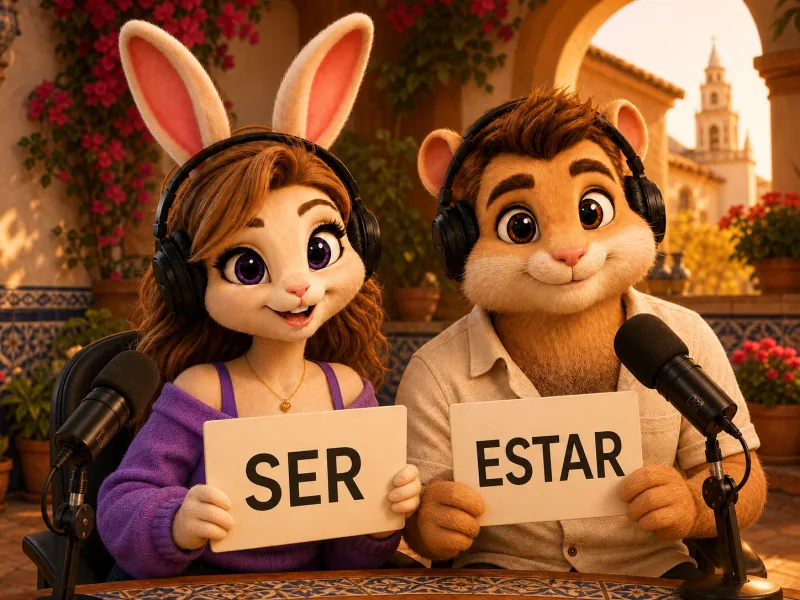
Ser vs Estar: Two Ways to Say “To Be”
In this episode, we explain the essential difference between ser and estar: how to talk about identity, origin, location, and current states, and how beginners can avoid common English-style mistakes.

The Structural Blueprint of French Sentences
In this episode, we explain the basic blueprint of French sentences: how subjects, verbs and objects work together, why word order matters, and how beginners can avoid direct translation mistakes.

The Hidden Logic of French Pronunciation
In this episode, we uncover the hidden logic of French pronunciation: why some letters stay silent, how sounds connect, and how beginners can start reading French more naturally.

Mastering the French Verb Être
In this episode, we explain how to master the French verb être: what it means, how to use its basic forms, and why it is essential for building simple French sentences.

Stop Being Your Age in French
In this episode, we explain why French uses avoir, not être, to talk about age: why you say j’ai 20 ans, not je suis 20, and how to avoid this classic beginner mistake.

The English Blueprint for Italian Sentences
In this episode, we explain the basic blueprint of Italian sentences: how subjects, verbs and objects work together, how word order works, and how beginners can avoid English-style mistakes.

How to Pronounce Any Italian Word
In this episode, we explain how to pronounce any Italian word: how letters match sounds, why vowels are clear and consistent, and how beginners can start reading Italian with confidence.
Language Learning Through Books
Read books, translate words, hear pronunciation, and save vocabulary.








Courses
All library sectionsPodcasts
All library sectionsThe Blueprint for Spanish Sentence Structure
In this episode, we explain the basic blueprint of Spanish sentence structure: how subjects, verbs and objects work together, why word order matters, and how beginners can avoid direct translation mistakes.
The Logical Architecture of Spanish Pronunciation
In this episode, we explain the logical architecture of Spanish pronunciation: how letters and sounds connect, why vowels stay consistent, and how beginners can read Spanish more naturally.
Why Spanish Speakers Drop Personal Pronouns
In this episode, we explain why Spanish often drops personal pronouns: how verb endings show who is doing the action, when pronouns are needed, and how beginners can avoid English-style mistakes.
The Logic of the Spanish Verb Ser
In this episode, we explain the logic of the Spanish verb ser: when to use it for identity, origin and essential qualities, and how beginners can avoid translating directly from English.
Using Estar for Location and Temporary States
In this episode, we explain how to use estar for location and temporary states: where someone or something is, how someone feels, and how to avoid confusing estar with ser.
Ser vs Estar: Two Ways to Say “To Be”
In this episode, we explain the essential difference between ser and estar: how to talk about identity, origin, location, and current states, and how beginners can avoid common English-style mistakes.
The Structural Blueprint of French Sentences
In this episode, we explain the basic blueprint of French sentences: how subjects, verbs and objects work together, why word order matters, and how beginners can avoid direct translation mistakes.
The Hidden Logic of French Pronunciation
In this episode, we uncover the hidden logic of French pronunciation: why some letters stay silent, how sounds connect, and how beginners can start reading French more naturally.
Mastering the French Verb Être
In this episode, we explain how to master the French verb être: what it means, how to use its basic forms, and why it is essential for building simple French sentences.
Stop Being Your Age in French
In this episode, we explain why French uses avoir, not être, to talk about age: why you say j’ai 20 ans, not je suis 20, and how to avoid this classic beginner mistake.
The English Blueprint for Italian Sentences
In this episode, we explain the basic blueprint of Italian sentences: how subjects, verbs and objects work together, how word order works, and how beginners can avoid English-style mistakes.
How to Pronounce Any Italian Word
In this episode, we explain how to pronounce any Italian word: how letters match sounds, why vowels are clear and consistent, and how beginners can start reading Italian with confidence.