
La máquina del tiempo
Volver a los libros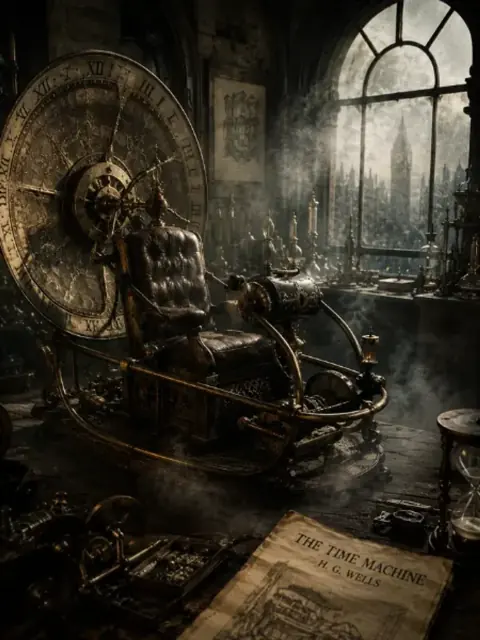
B2
La máquina del tiempo
H. G. Wells · EN · 32617 palabras
En esta emblemática novela corta de ciencia ficción, un curioso inventor victoriano construye una máquina capaz de viajar en el tiempo y la utiliza para trascender su propia época. Mientras explora el futuro lejano, descubre un mundo extraño y hermoso que oculta oscuros secretos bajo su superficie. A través de escenas vívidas y una aventura apasionante, la historia cuestiona el progreso, las divisiones de clase y el futuro de la humanidad. Accesible pero a la vez profunda, esta obra clásica invita a los lectores a imaginar el tiempo como una nueva dimensión y a reflexionar sobre el verdadero precio de la civilización.
Capítulo 1 de 176%
Inicia sesión para sincronizar tu progreso y guardar palabras en tus mazos.
Chapter I — Introduction
279 palabras · 2 min
The Time Traveller (for so it will be convenient to speak of him) was expounding a recondite matter to us. His grey eyes shone and twinkled, and his usually pale face was flushed and animated. The fire burnt brightly, and the soft radiance of the incandescent lights in the lilies of silver caught the bubbles that flashed and passed in our glasses. Our chairs, being his patents, embraced and caressed us rather than submitted to be sat upon, and there was that luxurious after-dinner atmosphere, when thought runs gracefully free of the trammels of precision. And he put it to us in this way—marking the points with a lean forefinger—as we sat and lazily admired his earnestness over this new paradox (as we thought it) and his fecundity.
“You must follow me carefully. I shall have to controvert one or two ideas that are almost universally accepted. The geometry, for instance, they taught you at school is founded on a misconception.”
“Is not that rather a large thing to expect us to begin upon?” said Filby, an argumentative person with red hair.
“I do not mean to ask you to accept anything without reasonable ground for it. You will soon admit as much as I need from you. You know of course that a mathematical line, a line of thickness nil, has no real existence. They taught you that? Neither has a mathematical plane. These things are mere abstractions.”
“That is all right,” said the Psychologist.
“Nor, having only length, breadth, and thickness, can a cube have a real existence.”
“There I object,” said Filby. “Of course a solid body may exist. All real things—”
“So most people think.
Regístrate o inicia sesión para leer y escuchar el libro completo.