
Cỗ máy thời gian
Quay lại sách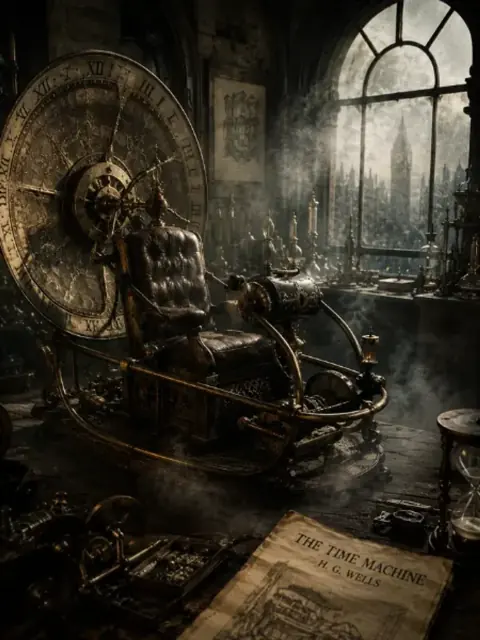
B2
Cỗ máy thời gian
H. G. Wells · EN · 32617 từ
Trong cuốn tiểu thuyết khoa học viễn tưởng kinh điển này, một nhà phát minh thời Victoria tò mò chế tạo một cỗ máy có thể du hành xuyên thời gian và sử dụng nó để vượt xa thời đại của mình. Khi khám phá tương lai xa xôi, ông phát hiện ra một thế giới kỳ lạ và tươi đẹp ẩn chứa những bí mật đen tối bên dưới bề mặt. Thông qua những cảnh tượng sống động và cuộc phiêu lưu hấp dẫn, câu chuyện đặt ra những câu hỏi về sự tiến bộ, sự phân chia giai cấp và tương lai của nhân loại. Dễ hiểu nhưng đầy suy ngẫm, tác phẩm kinh điển này mời gọi người đọc tưởng tượng về thời gian như một chiều không gian mới và suy ngẫm về cái giá thực sự của nền văn minh.
Chương 1 / 176%
Đăng nhập để đồng bộ tiến độ đọc và lưu từ vào bộ thẻ.
Chapter I — Introduction
279 từ · 2 phút
The Time Traveller (for so it will be convenient to speak of him) was expounding a recondite matter to us. His grey eyes shone and twinkled, and his usually pale face was flushed and animated. The fire burnt brightly, and the soft radiance of the incandescent lights in the lilies of silver caught the bubbles that flashed and passed in our glasses. Our chairs, being his patents, embraced and caressed us rather than submitted to be sat upon, and there was that luxurious after-dinner atmosphere, when thought runs gracefully free of the trammels of precision. And he put it to us in this way—marking the points with a lean forefinger—as we sat and lazily admired his earnestness over this new paradox (as we thought it) and his fecundity.
“You must follow me carefully. I shall have to controvert one or two ideas that are almost universally accepted. The geometry, for instance, they taught you at school is founded on a misconception.”
“Is not that rather a large thing to expect us to begin upon?” said Filby, an argumentative person with red hair.
“I do not mean to ask you to accept anything without reasonable ground for it. You will soon admit as much as I need from you. You know of course that a mathematical line, a line of thickness nil, has no real existence. They taught you that? Neither has a mathematical plane. These things are mere abstractions.”
“That is all right,” said the Psychologist.
“Nor, having only length, breadth, and thickness, can a cube have a real existence.”
“There I object,” said Filby. “Of course a solid body may exist. All real things—”
“So most people think.
Đăng ký hoặc đăng nhập để đọc và nghe toàn bộ cuốn sách.