
De tijdmachine
Terug naar boeken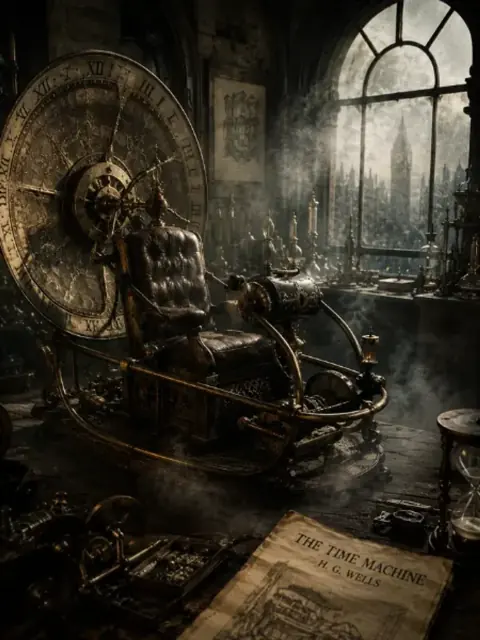
B2
De tijdmachine
H. G. Wells · EN · 32617 woorden
In deze baanbrekende sciencefictionnovelle bouwt een nieuwsgierige Victoriaanse uitvinder een machine waarmee hij door de tijd kan reizen en gebruikt deze om ver voorbij zijn eigen tijdperk te springen. Terwijl hij de verre toekomst verkent, ontdekt hij een vreemde en prachtige wereld die duistere geheimen verbergt. Door middel van levendige scènes en meeslepende avonturen stelt het verhaal vragen over vooruitgang, klassenverschillen en wat er met de mensheid zal gebeuren. Toegankelijk maar tegelijkertijd tot nadenken stemmend, nodigt deze klassieker de lezer uit om tijd als een nieuwe dimensie te beschouwen en na te denken over de werkelijke prijs van de beschaving.
Hoofdstuk 1 van 176%
Log in om je voortgang te synchroniseren en woorden in sets op te slaan.
Chapter I — Introduction
279 woorden · 2 min
The Time Traveller (for so it will be convenient to speak of him) was expounding a recondite matter to us. His grey eyes shone and twinkled, and his usually pale face was flushed and animated. The fire burnt brightly, and the soft radiance of the incandescent lights in the lilies of silver caught the bubbles that flashed and passed in our glasses. Our chairs, being his patents, embraced and caressed us rather than submitted to be sat upon, and there was that luxurious after-dinner atmosphere, when thought runs gracefully free of the trammels of precision. And he put it to us in this way—marking the points with a lean forefinger—as we sat and lazily admired his earnestness over this new paradox (as we thought it) and his fecundity.
“You must follow me carefully. I shall have to controvert one or two ideas that are almost universally accepted. The geometry, for instance, they taught you at school is founded on a misconception.”
“Is not that rather a large thing to expect us to begin upon?” said Filby, an argumentative person with red hair.
“I do not mean to ask you to accept anything without reasonable ground for it. You will soon admit as much as I need from you. You know of course that a mathematical line, a line of thickness nil, has no real existence. They taught you that? Neither has a mathematical plane. These things are mere abstractions.”
“That is all right,” said the Psychologist.
“Nor, having only length, breadth, and thickness, can a cube have a real existence.”
“There I object,” said Filby. “Of course a solid body may exist. All real things—”
“So most people think.
Registreer je of log in om het hele boek te lezen en te beluisteren.